Pressure Washing vs Soft Washing
Pressure washing cleans with force. Soft washing cleans with a cleaning solution applied at low pressure and given time to work. Which one a surface needs depends on the material, the manufacturer’s instructions and its condition, so there is no single answer for a whole house. This page sets out what the manufacturers and trade bodies actually say, surface by surface.

What is pressure washing?
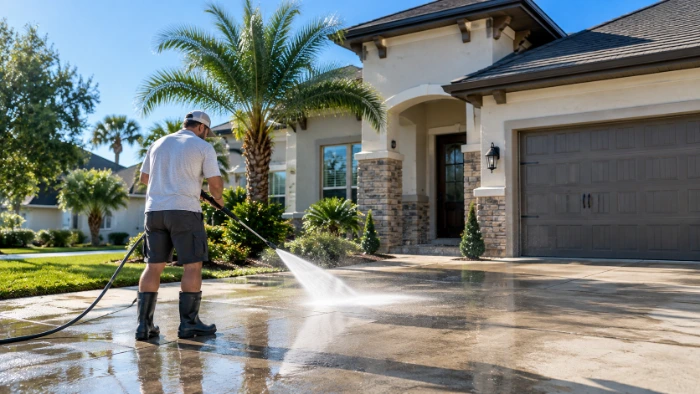
Pressure washing uses a pump to push water through a narrow nozzle at high pressure, and the force of the water does most of the cleaning. On sound concrete that is the point: force lifts growth and grime out of a hard, porous surface. ICPI, the concrete paver industry body, gives professional pressure washers a range of 1,000 to 4,000 psi at 2 to 6 gallons per minute.
What is soft washing?
Soft washing applies a cleaning solution at low pressure, leaves it to dwell, then rinses at low pressure. The solution kills and loosens organic growth such as algae and mildew, and the water only carries it away. The clearest published example is the method the Asphalt Roofing Manufacturers Association (ARMA) gives for shingle roofs: equal parts bleach and water, left for 15 to 20 minutes, then rinsed gently.
What is the actual difference?
What does the cleaning. With pressure washing it is force. With soft washing it is the solution and the time it is given. That changes the risk: force can remove the surface as well as the dirt on it, while a cleaning solution has to be kept away from plants and rinsed properly.
Is soft washing simply lower PSI?
No. Turning the pressure down without a cleaning solution is just a weaker rinse, and it will not clear algae the way a solution does. Lower pressure is part of soft washing, not the definition of it.
There is also no official pressure cut-off. Figures such as “under 500 psi” or “60 to 150 psi” circulate widely, but we could not find a trade body that sets one. The Pressure Washers of North America certification material describes house washing as a low pressure method without giving a number. The useful limits are the ones each manufacturer publishes for its own product, below.
Does every surface need the same method?
No, and the manufacturers do not even agree with each other within one material. This is what each source says.
| Surface | What the guidance says | Source |
|---|---|---|
| Asphalt shingle roof | Never use a pressure washer; it causes granule loss. No brush or broom. Bleach solution, dwell, gentle rinse. | ARMA |
| Vinyl siding | Manufacturers disagree. CertainTeed does not recommend power washing. Georgia-Pacific allows 1,500 to 2,400 psi with a 40-degree tip, at eye level, never aimed upward. | CertainTeed, Georgia-Pacific |
| Fibre cement (James Hardie) | Garden hose and soft brush recommended. If a pressure washer is used: wide fan tip, under 1,500 psi, at least 6 feet away. Damage from improper cleaning may not be covered by the warranty. | James Hardie, Technical Bulletin 20 |
| Acrylic stucco finish | Routine cleaning at about 200 to 500 psi, nozzle several feet away, never above 500 psi. | Sto |
| Concrete pavers | Pressure washing is acceptable. Use a wide spray and a low angle so joint sand is not washed out. Refill joints if needed. | ICPI Tech Spec 5, Unilock |
| Composite decking (Trex) | Current lines: up to 3,100 psi, fan tip, at least 8 inches away. Early-generation boards: do not pressure wash. | Trex |
| Wood decks | Aggressive scrubbing or power washing can remove wood from the surface, especially soft woods such as cedar. | USDA Forest Products Laboratory |
Sources checked September 2026. Manufacturers update their guidance, and the instructions for your specific product override anything general, including this table.
When is pressure appropriate?
On hard, sound, horizontal surfaces: concrete driveways, walkways, sidewalks, patios and pool decks, and on pavers with the technique ICPI describes. Some composite decking also allows it within the manufacturer’s limit. Even here the pressure, nozzle and distance are chosen for the surface rather than set to maximum.
When is pressure inappropriate?
- When the manufacturer says so. ARMA for shingle roofs, CertainTeed for its vinyl, early Trex boards.
- When it would drive water where it should not go. The Polymeric Exterior Products Association warns that spraying siding upward can force water behind the panels.
- When the surface is already weak. Chalking or flaking paint, soft mortar, cracked stucco and dusting concrete can all lose material under pressure. The concrete industry uses high pressure water deliberately to strip a weak surface layer in repair work (NRMCA), which shows what it can do to a surface you want to keep.
What should be used on siding?
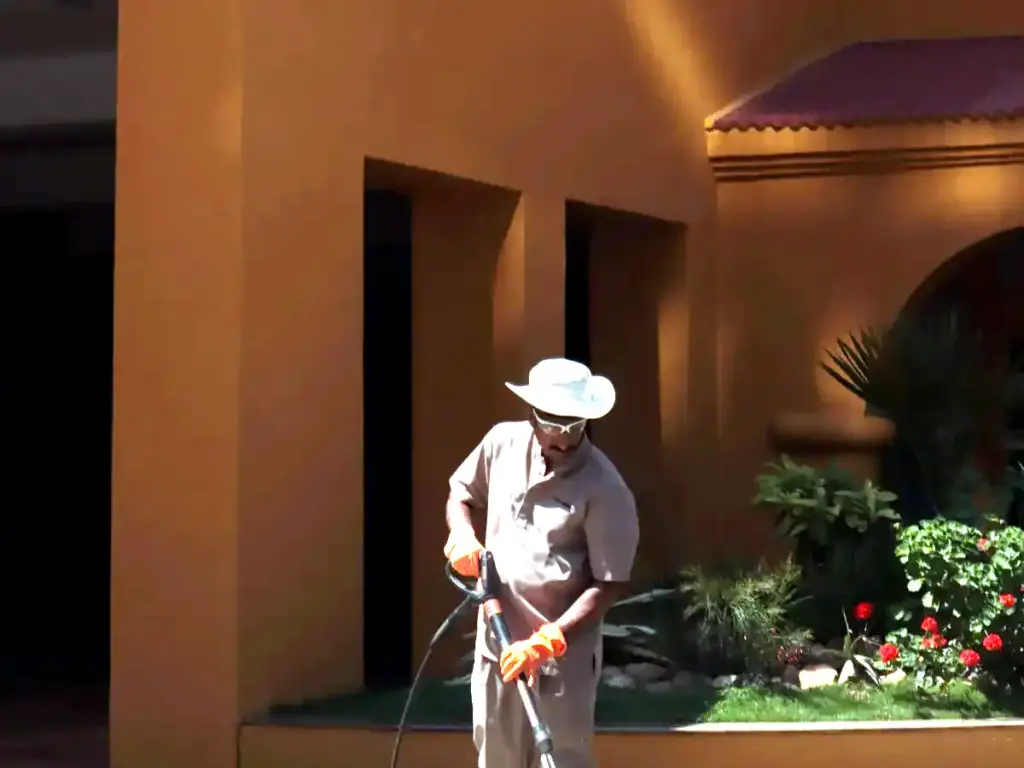
Low pressure with a cleaning solution, within whatever limit the siding manufacturer sets. Where manufacturers differ, as they do on vinyl, the stricter instruction is the safer one unless you know the exact product. Stucco and fibre cement have their own published limits in the table above. See house washing for how that works on a Jacksonville home.
What should be used on concrete?
Pressure washing, usually with a rotary surface cleaner for an even finish, plus a pre-treatment where there is heavy growth, oil or rust. Pavers need a wide spray and a low angle so the joint sand stays in. Concrete that is flaking, dusting or very new deserves a conversation about pressure before anyone starts. See driveway and concrete cleaning.
What should be used on asphalt shingles?
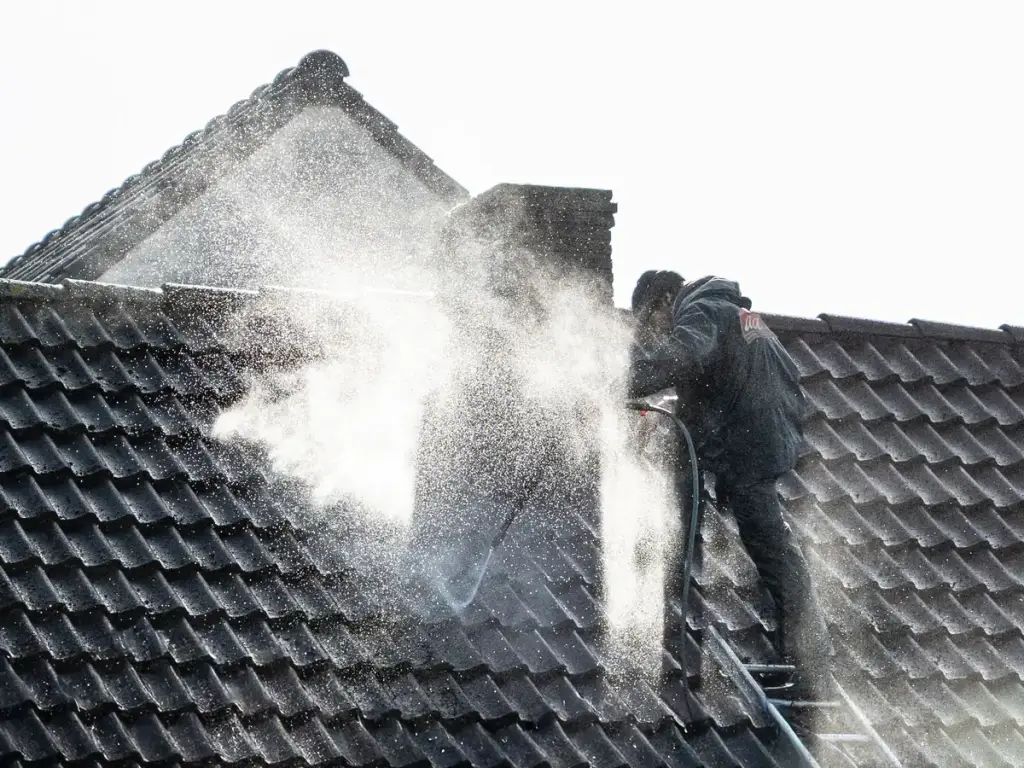
A soft wash. ARMA’s method is a cleaning solution, dwell time and a gentle rinse, with no pressure washer, brush or broom. The granules on a shingle give it its colour and protect the asphalt from ultraviolet light, and ARMA links pressure washing directly to losing them. See roof cleaning.
Can you pressure wash a roof?
Not an asphalt shingle roof. ARMA says a pressure washer should never be used on one, because it causes granule loss and likely premature roof failure. Tile and metal roofs are different materials with different risks, including cracked tiles and coated finishes, and we have not found an equivalent industry standard for them, so the roof’s condition and any manufacturer guidance decide the method there.
How should a homeowner decide?
- Name the material. Vinyl, stucco, fibre cement, painted wood, shingle, concrete or pavers. If you do not know, a contractor should identify it before quoting.
- Look for the manufacturer’s instructions. They override general advice, and some warranties depend on them.
- Check the condition. Failing paint, soft mortar, cracks and loose granules all push towards gentler methods.
- Ask the contractor two questions. What pressure will you use on each surface, and what cleaning solution? A contractor with one answer for every surface is the risk.
- Ask how plants will be protected. University extension services advise covering plants or rinsing them promptly when bleach-based cleaners are used nearby (Iowa State University Extension).
Most homes need both methods: soft washing for the walls and roof, pressure for the driveway and walkways. That is how we quote. See the Jacksonville pressure washing services overview.
Get a quote that names the method
Tell us the surfaces and we will tell you which method each one needs, in writing, before any work starts.